BbWorld '13 Epilogue
I've been back in the saddle (ok, the desk chair) for over a week, which is probably enough time to gestate, percolate, or otherwise regurgitate some overarching themes and miscellaneous asides from the Blackboard World client conference. So, here goes, in no particular order:
Being a VIP Blogger
My chief concern about being picked as a blogger was "did anyone at Bb actually
read my
entry"? I still suspect the answer is "no", but Bb middle and upper management are by now well aware that my sarcasm-tipped darts are delivered in order to address a particular end-user concern. In session with Bb reps from support, development and product management, when I took the floor to pose a particularly vexing question about a lingering bug, one Bb staffer acknowledged "Greg
always asks the hard questions". Yes; yes, I do-because they need to addressed. And to be fair, Bb listens and typically finds a resolution to our needs.
The odd bits of this self-selected tour of duty? I have no issues reacting to presentations or sessions on the fly via
Twitter. The amusing thing is when your snark gets picked up and redistributed by the masses. It moved from somewhat surreal to downright Dada-esque when an Inside Higher Ed reporter hit me with "your tweets are funny; can I interview you about OpenSUNY"? Uhm, sure...I guess.
The only regret is that I didn't spend a great deal of time getting to know my fellow bloggers. A very interesting bunch, with at least one Google Glass tester among them. As much as I love to make new contacts and form relationships, there's always the warm snuggly blanket of my existing network (who at this point I'll see once a year if I'm lucky). So, again, sorry to my paparazzi circle that I didn't get to know you better as individuals.
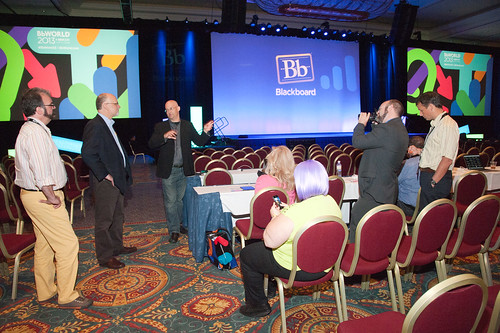
(Bloggers chatting with keynote Clay Shirkey)
The More Things Change..
This particular user conference marked the change in leadership from Michael Chasen to Jay Bhatt as CEO. Aside from personality differences that drive one's podium style, the biggest change was somewhat unspoken. Although Mr. Bhatt
emphasized a renewed focus on innovation, driving needed functionality changes within the core products, and closing (some very evident) gaps across product lines to move towards tighter integration, there are some interesting things that underscore this strategy that were
not immediately evident. Let's take a closer look:
Mobile matures
We saw needed changes forecast for Mobile- namely, grading access for faculty, and polling functionality for students. But another change was apparently in place- namely, the absence of Mobile General Manager Kayvon Beykpour from the keynote podium. Phil Hill
reports that Beykpour is on a "leave of absence"; in the past, he seemed to equally share the spotlight with Chasen and Ray Henderson. This may signify that the rather independent and Wild West direction of the Mobile line may indeed be pulled in to support Learn better than it has to date.
Hello, my name is...
I really couldn't tell you exactly how many VPs or AVPs still under warranty I was introduced to, but it would appear that a pretty good sized
shakeup of upper/middle management is underway.Not surprisingly, some of the talent comes from Autodesk, one of Mr. Bhatt's former leadership posts. At least one of these new hires had been on payroll only a handfull of days prior to BbWorld. I'd also say that Mr. Bhatt is still in the midst of his own learning curve, as some of his comments in the Chronicle interview demonstrate (hint: don't refer to higher ed as an "industry"; we even find "business" to be a dirty word).
Who's afraid of Canvas?
Previous years saw the co-opting of open source platforms Moodle (via
the acquisition of MoodleRooms) and Sakai (via leveraging the credibility of "
Dr. Chuck" Severence, otherwise known as the godfather of Sakai). While MR had booth space on the tradeshow floor, I don't believe I heard one reference to the hosted Moodle offering from the keynote stage the whole week. Even more interesting, the Sakai booth from past years had completely disappeared. Wherefore art thou, open source alliance? A particularly well positioned source (who I'm not going to identify b/c I wasn't wearing my "Press" card in my fedora) posited this answer to me: previously,
Canvas was perceived as the Disruptor Who Will Eat Our Lunch. Canvas pretty much played to it's own self-defined smart-ass new kid approach, staging a guerilla event under the Bb Overlords' noses at the '12 confab in Vegas. If you can connect the dots, you'll see how alignment and acquisition of highly visible open source alternatives was a move to keep Bb's on the fence legacy customers (ANGEL and WebCT) in the fold by offering "in house" alternatives. My informant told me that while Canvas still continues to demo well to prospects, the actual conversion rate from potential dance partner to paying customer hasn't exactly been stellar.
Couple this with a refocused effort on fixing wonky issues in Bb while actually adding needed functionality, and you can see the scales begin to rebalance themselves. One barrier to progress may have been the former CEO himself; another source related to me that unless new product development could demonstrably drive adding new customers, then requests for enhancements or fixes were often vetoed by Mr. Chasen. Mr. Bhatt is clearly rebooting the system, clearing the clogged pipes, whatever metaphor you wish to deploy -with the goal of
retaining customers and demonstrating competency
Taking these two things in tandem - Canvas revealing it's own flaws over time, and rejiggering the organization to increase the speed of innovation - and you can see that the need to offer alternative LMS platforms has actually lessened. It remains to seen what the long-term strategy for MoodleRooms is in terms of growing it's own market share. It also remains to be seen whether Josh Coates, Instructure's CEO, can move from his bratty teenager phase to a more mature adult role.
Is this really a sea change?
From my perspective, putting Mr. Bhatt in the driver's seat, and retracting the need to focus on revenue by pulling back from being publicly traded, Blackboard has the opportunity to really charm it's existing customer base by enhancing the core products, making an actually integrated suite that supports different use cases (asynchronous, synchronous, and "on the go" mobile touch points), and shoring up some antiquated underpinnings of Learn. Moreover, some development under the umbrella of "personalization" should align Learn well with evolving needs for flexible or alternative delivery models in the higher ed space (full disclosure: I have been a constant nag with product about these concepts, and I couldn't be more delighted in terms of where it's headed). Maybe there's a little tail wagging the dog in terms of "bolt on" ideas from the marketplace such as MOOCs and badging (again, disclosure:
SUNY's OER-101 MOOC helped drive the investigation on integrating badging), but overall the ship seems to be sailing in the right direction.
(ps. yes, I did enjoy "the Streets of San Francisco" as a kid, for those who can spot the reference)
